

Experimentation as Everyday Marketing Practice | Marketing Experimentation Strategy
Marketing is decision making under uncertainty. Adopting a marketing experimentation strategy allows you to test your assumptions in real-time without the fear of failing.
Why a Marketing Experimentation Strategy Is Not Optional

A common misunderstanding is that experimentation belongs only to large teams with analysts. In practice, it belongs to anyone responsible for a decision that costs time, money, or reputation.
When the cost of being wrong is real, a test is not a luxury.
Many plausible ideas do not improve the outcome they were designed to improve. Without testing, it is easy to build a strategy on something that sounds right but does not change behaviour.
Where experimentation actually shows up
A typical day in marketing involves dozens of small decisions.
Which headline is used. Which creative is favoured. Which landing page is linked. Which audience is excluded. Which email is sent. Which budget is increased.
Each of these decisions is a claim about what will happen next.
When results move, it is natural to assume the change caused the movement. It is also often wrong.
A fair comparison is what turns movement into evidence.
Your Marketing Experimentation Strategy Blueprint

Developing a clear Marketing Experimentation Strategy is what separates justified confidence from confident guessing.
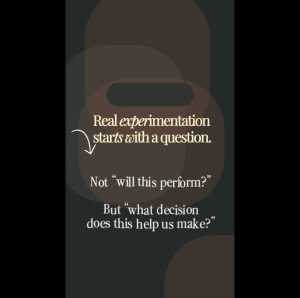
Every experiment should begin with a decision.
What choice will this test settle?
Keep the structure simple:
Decision
What will change based on the result?
Change
Introduce one meaningful change only.
Primary Outcome
Choose one metric that represents success.
Guardrails
Define what must not get worse.
Duration
Run the test long enough to reflect normal variation.
If you change multiple things at once, you will usually learn one thing with confidence: You changed multiple things at once.
What to test by buyer stage
Experiments are most effective when they match where the buyer is in their journey.
Awareness
Test language and framing.
Does the audience understand who this is for and what it does?
Consideration
Test structure and reassurance.
Does the order of information reduce confusion?
Decision
Test effort and risk.
Does reducing friction increase completion?
Early stages require clarity. Later stages require reduced effort and reduced uncertainty.
Reading results with clarity
A measurable change is not always a meaningful one.
Results should be interpreted in relation to goals, not in isolation.
Positive outcome
If performance improves and quality remains stable, adopting the change is reasonable.
Neutral outcome
Small differences may be normal variation. This often means the test did not address the real problem.
Negative outcome
If results decline or quality drops, revert quickly and identify the likely cause.
The goal is not to prove that something happened.
The goal is to understand what should happen next.
A note on interpretation
Data does not remove uncertainty. It helps locate it.
Prefer rates over raw counts.
Separate leading and lagging indicators.
Watch at least one signal of quality.
Allow results to survive normal variation.
You do not need perfect precision. You need dependable direction.
What this changes
When experimentation is approached this way:
Fewer tests are needed.
Data becomes easier to interpret.
Decisions become clearer.
Momentum feels calmer.
Progress stops being about volume and starts being about resolution.
Closing
Marketing does not fail because people do not try hard enough. It falters when effort is applied without shared understanding.
Experimentation is not about activity. It is about making better decisions.
Is your current marketing experimentation strategy failing?
Check your foundation before you test anything.
The aim is not to produce more reports. The aim is to improve judgment.

Want the full guide?
Download the complete framework, including templates and examples.